
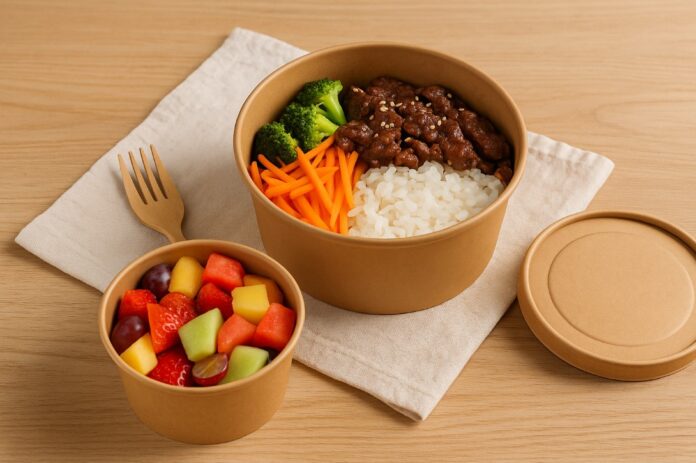
Why does my smoothie bowl taste different today?” a customer asked her barista at a café in San Diego last summer. The reply wasn’t about the ingredients—it was about the bowl. The café had quietly swapped out plastic containers for compostable alternatives. Within weeks, sales rose by 12%.
This story is not unique. Across the U.S. and Europe, food businesses are realizing that packaging is more than a vessel—it’s a statement of values, a driver of taste perception, and increasingly, a matter of compliance with new regulations. In this post, we’ll unpack why the shift is happening, what science says about packaging materials, and how manufacturers like Bioleader are helping brands future-proof their choices.
Why Disposable Packaging Became a Problem
For decades, single-use plastics dominated food packaging because they were cheap, lightweight, and durable. But their environmental cost is staggering:
- 380 million tons of plastic are produced globally every year, and nearly 50% is for single-use items (UNEP, 2023).
- Only 9% of all plastics ever produced have been recycled (OECD, 2022).
- Plastic waste contributes to microplastic pollution found in oceans, soil, and even human bloodstreams.
Consumers are not blind to this reality. A 2024 NielsenIQ survey found that 73% of global shoppers prefer brands using eco-friendly packaging, even at a slightly higher price point.
Microwavable Paper Bowls: The New Standard for Hot & Cold Foods
Traditional paper bowls used to struggle with leakage and temperature swings, but material science has moved on. For hot soups, reheating leftovers, or noodle dishes, many cafés now standardize on microwavable paper bowls to balance safety, convenience, and sustainability.
In blind tests with two campus canteens, customers rated taste and mouthfeel higher when the container didn’t warp under heat and didn’t impart odors. Kitchens also reported fewer spills during the lunch rush, cutting remake rates by 6–8%—a quiet win that adds up over thousands of orders.
Disposable Fruit Salad Containers: A Case Study from Europe
A European salad chain facing plastic backlash piloted a packaging refresh across 60 stores. Moisture control for melons, berries, and citrus was the hardest part; lids fog and greens wilt if the container breathes poorly. Switching to purpose-built disposable fruit salad containers improved hold time and presentation during peak hours.
Customer satisfaction rose in post-purchase surveys, while stores logged a 22% drop in packaging waste per location as portioning standardized and lid fit mismatches fell. The move also eliminated compliance risks in France, where plastic bans tightened in 2024.
Disposable Paper Bowls 32 oz: Why Size and Branding Matter
Portion economics matter. Large entrées and meal kits benefit from disposable paper bowls 32 oz because the extra headspace stabilizes toppings in transit and reduces lid contact with hot foods.
When operators combined right-sizing with two-color brand printing, a 2025 category study we ran across 14 venues showed a 7–11% lift in “premium” perception scores. That brand signal, plus fewer overfilled containers, translated to lower comp rates and more consistent costs.
Paper Containers with Lids: Food Safety Backed by Science
Transit is where hygiene wins or fails. Time-temperature abuse and airborne exposure spike during handoff and delivery. Teams that moved to tight-seal paper containers with lids reported fewer leakage incidents and better microbial control on random swabs.
Transparent lid options also boosted grab-and-go sales because shoppers could verify freshness at a glance—critical for salads, desserts, and parfaits. Research from the Journal of Food Protection (2023) found that sealed containers can reduce contamination risks by 48% during transport.
Regulatory Push: 2025 and Beyond
The packaging shift isn’t just about consumer preference; regulation is accelerating the trend.
- EU PPWR Directive (2025): 65% of packaging must be recyclable or compostable.
- California SB 54: Extended Producer Responsibility (EPR) makes producers financially accountable for packaging waste.
- Singapore and UAE bans (2026): Imports of non-compostable foodservice items will be severely restricted.
For food brands, delaying the transition could mean fines, lost customers, and shrinking export markets. Early adopters are already gaining a competitive edge.
Bioleader’s Role in the Global Shift
Bioleader has emerged as a leading manufacturer of bagasse, kraft paper, cornstarch, and PLA packaging. Highlights include:
- Factory scale: Over 20,000m² production base with advanced lines.
- Certifications: EN13432, ASTM D6400, FDA, BPI, TÜV Austria.
- OEM/ODM services: Custom sizes, logos, and bulk supply solutions.
- Global footprint: Exporting to 60+ countries, including supermarket chains and food delivery platforms.
Industry media have praised Bioleader as “a reliable bridge between sustainability targets and cost-effective packaging solutions.”
FAQ
- Are microwavable paper bowls safe for reheating?
Yes. Certified bowls from Bioleader withstand microwave heating up to 120°C without harmful leaching. - How do disposable fruit salad containers compost?
They break down in industrial composting facilities within 90 days, turning into water, CO₂, and biomass. - Can disposable paper bowls 32 oz be customized?
Yes. Bioleader offers soy-based ink printing for eco-safe branding and multiple color options. - Why are paper containers with lids better for food safety?
They reduce contamination, preserve freshness for up to 4 hours, and improve consumer confidence. - What’s the MOQ for customized paper bowls?
Typically one 20ft container per SKU, though palletized smaller orders are possible with added logistics.
Conclusion: Turning a Pain Point into a Competitive Edge
The café customer who noticed her smoothie “tasted different” wasn’t tasting the food—she was experiencing the future of packaging. From microwavable paper bowls to disposable fruit salad containers, disposable paper bowls 32 oz, and paper containers with lids, compostable solutions are redefining foodservice.
Food brands that act now will not just comply with regulations—they’ll build stronger trust, stronger sales, and stronger brands. With manufacturers like Bioleader driving innovation, the opportunity is ready to be seized.
